The Invisible Pillars of Plant Health
While lights provide energy and nutrients provide building blocks, the atmosphere within your indoor greenhouse dictates how efficiently your plants can process both. Humidity and airflow are completely intertwined; you cannot adjust one without significantly impacting the other. Poor climate control is the leading cause of indoor crop failure, manifesting as powdery mildew, stunted growth, or nutrient lockout.
Vapor Pressure Deficit (VPD) Explained
To truly master an indoor greenhouse, growers look beyond simple Relative Humidity (RH) percentages and utilize a metric known as Vapor Pressure Deficit (VPD). VPD combines temperature and relative humidity to measure the drying power of the air.
Plants "breathe" and pull water up through their roots via a process called transpiration. If the air is too humid (low VPD), the plant cannot transpire because the air is already saturated. This halts nutrient uptake, leading to deficiencies even if the soil is perfectly balanced. Conversely, if the air is too dry (high VPD), the plant transpires too rapidly. To protect itself from desiccation, it will close its stomata (the pores on its leaves), which entirely halts photosynthesis.
The goal is a balanced VPD that encourages a steady flow of water and nutrients from the roots to the leaves. For most vegetative growth, a VPD between 0.8 and 1.2 kPa is ideal. As plants move into flowering or fruiting stages, a slightly drier environment (1.2 to 1.5 kPa) helps prevent bud rot and fungal infections.
Airflow: Exhaust and Circulation
Managing the atmosphere requires two distinct types of ventilation: extraction (exhaust) and internal circulation.
Extraction Systems
Your enclosed greenhouse requires a constant exchange of air to replenish CO2 and exhaust excess heat and humidity. An inline exhaust fan, typically mounted at the top of the enclosure (since heat rises), pulls stale air out. As air is expelled, fresh air is drawn in through passive intake vents located near the bottom of the structure. This continuous upward flow ensures the plant canopy is bathed in fresh CO2-rich air.
Internal Circulation
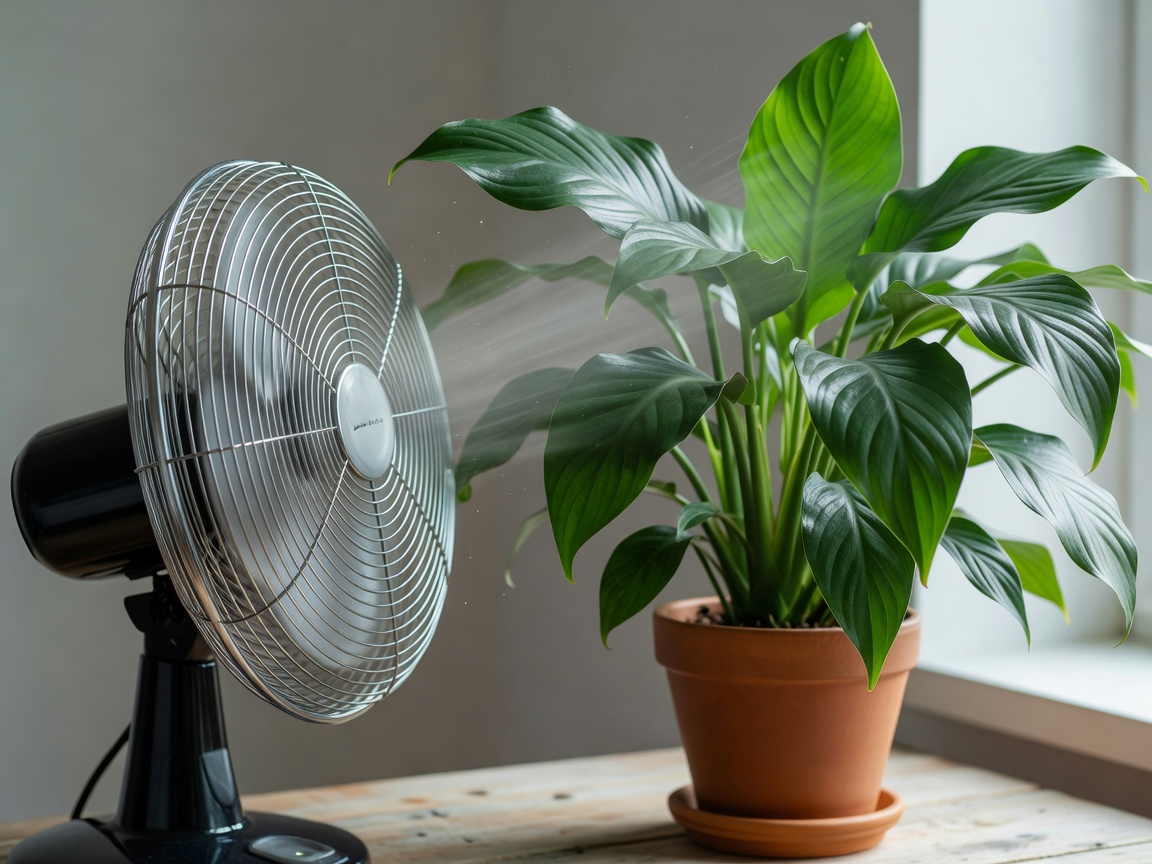
Simply pulling air through the tent is not enough. You must also disrupt the micro-climate that forms immediately around the plant leaves. As a plant transpires, a tiny layer of humid, stagnant air envelopes the leaf surface, which can stifle further transpiration. Oscillating clip fans strategically placed above and below the canopy break up this boundary layer.
Circulation fans also mimic outdoor wind, mechanically stressing the plant stems just enough to encourage them to grow thicker and stronger, capable of supporting heavy yields.
Tools for Climate Control
- Humidifiers / Dehumidifiers: Depending on your lung room (the room housing the greenhouse), you may need mechanical intervention. Ultrasonic humidifiers are excellent for raising humidity in dry winter months, while dedicated dehumidifiers become crucial during late flowering stages.
- Smart Controllers: Automated environmental controllers take the guesswork out of the equation. By connecting your exhaust fans and humidifiers to a smart sensor, the system will automatically power devices on and off to maintain your target VPD seamlessly.
Finding the balance takes patience. Start by monitoring your baseline room parameters before introducing plants, and calibrate your fans accordingly. A dialed-in environment is the secret to pest-free, vigorous indoor cultivation.