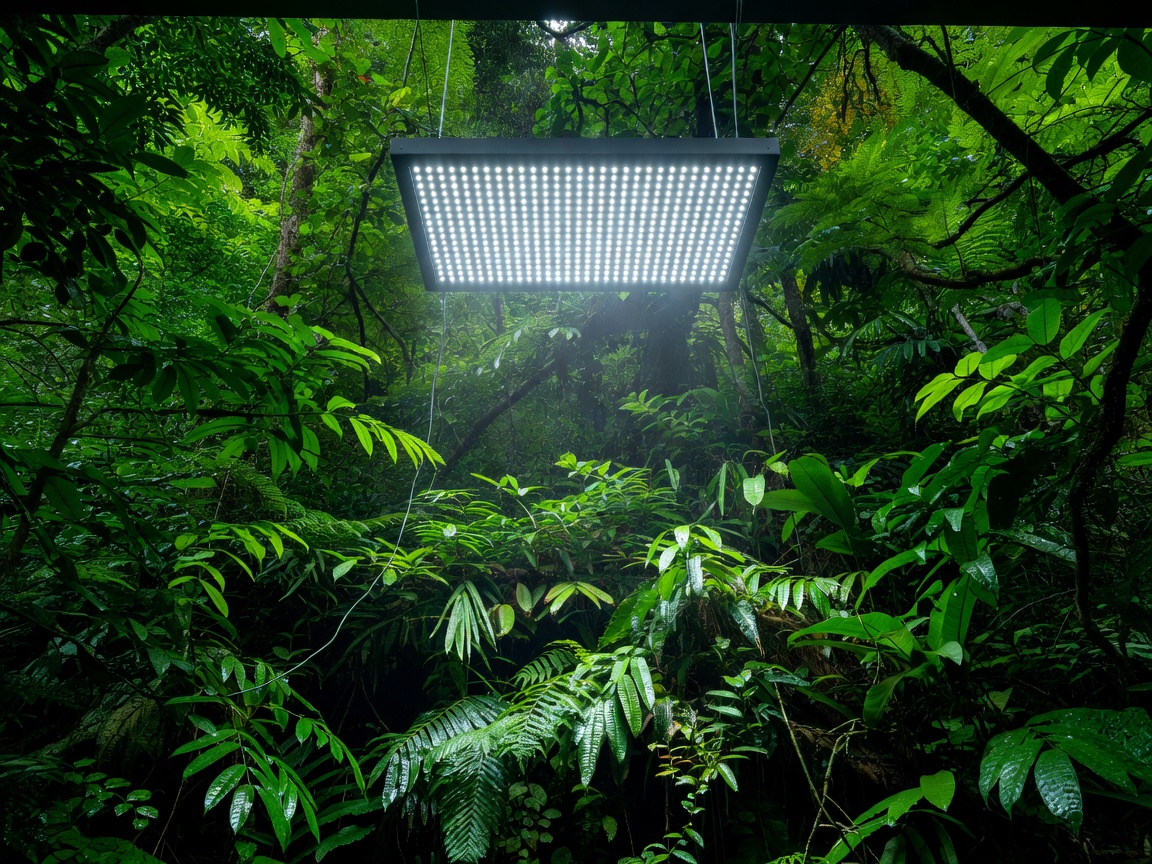
The Engine of Your Indoor Greenhouse
In an outdoor garden, the sun dictates the rhythm of life, providing a full, uncompromised spectrum of light energy. When moving cultivation indoors, replicating this powerhouse requires precise technological intervention. Selecting the correct lighting system is arguably the most critical investment for your indoor greenhouse, directly impacting plant structure, growth rate, and final yield.
Navigating the grow light market can be overwhelming due to a barrage of acronyms: PAR, PPFD, DLI, and spectrum curves. Understanding these metrics shifts your decision-making from relying on marketing buzzwords (like "wattage equivalent") to understanding the actual photons hitting your plant canopy.
Understanding the Metrics
To evaluate a light accurately, we must measure what the plant "sees", not just how bright the light appears to the human eye. Human vision is tuned heavily to green and yellow light (measured in Lumens), whereas plants rely heavily on red and blue wavelengths for photosynthesis.
1. PAR (Photosynthetically Active Radiation)
PAR designates the spectral range of solar radiation from 400 to 700 nanometers. This is the exact range of light that photosynthetic organisms are able to use in the process of photosynthesis. A grow light's quality is partially defined by how well its output aligns with the PAR spectrum.
2. PPFD (Photosynthetic Photon Flux Density)
If PAR is the *type* of light, PPFD is the *amount* of that light actually reaching the plant canopy. Measured in micromoles per square meter per second (µmol/m²/s), PPFD tells you the density of light hitting a specific area. A light may output high amounts of photons, but if it is hung too high or lacks focused reflectors, the PPFD at the canopy will be insufficient. Most leafy greens thrive around 200-400 µmol/m²/s, while fruiting plants may require 600-1000 µmol/m²/s.
3. DLI (Daily Light Integral)
DLI measures the total volume of photosynthetically active photons accumulated over a 24-hour period. Think of PPFD as the speed you are driving, and DLI as the total distance covered. If your light has a lower PPFD, you can sometimes compensate by leaving the light on for longer hours to reach the target DLI for your specific crop.
The Dominance of LED Technology
Historically, High-Intensity Discharge (HID) lights, such as High-Pressure Sodium (HPS) and Metal Halide (MH), were the industry standard. While effective, they produce massive amounts of excess heat and draw heavy electricity. Today, modern LED (Light Emitting Diode) panels have entirely taken over both commercial and hobbyist indoor spaces.
Full-spectrum white LEDs offer an excellent balance. They utilize blue wavelengths to promote tight, bushy vegetative growth, preventing plants from stretching and becoming "leggy." Meanwhile, the red wavelengths drive robust flowering and fruiting. Unlike older "blurple" (blue/purple) LEDs, modern full-spectrum boards output a pleasant, natural white light that makes it easier to visually inspect your plants for nutrient deficiencies or pests.
Setting Up Your Lighting Array
When installing lights in your indoor greenhouse, uniform coverage is key. The center of your grow space will always receive the highest PPFD, with intensity dropping off near the edges. To combat this, look for fixtures with a wide footprint or utilize reflective materials on the interior walls of your greenhouse enclosure (such as Mylar or flat white paint) to bounce stray light back toward the canopy.
Heat management, even with LEDs, remains important. While LEDs do not radiate intense infrared heat downward onto the plants like HPS bulbs, the electrical drivers mounted on the back of the panels do get hot. Ensure your greenhouse ventilation system is adequate to pull this ambient heat away from the upper canopy.